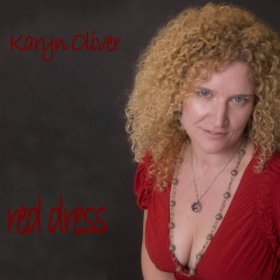
Karyn Oliver: Red Dress
I was recently fortunate enough to email interview Baltimore-based singer/songwriter Karyn Oliver about her 2010 CD, Red Dress (Amazon and iTunes). As detailed at her Facebook page, the CD was produced “by Thomm Jutz (Nanci Griffith) and featuring an all-star cast of experienced Nashville musicians, Red Dress shows Oliver at her sultriest (Right Now), bittersweetly melancholy (Candy Dish), and playfully flirtatious (Baby Don’t Speak). October Day transforms one woman’s story into a universal message about dreams that are lost and then recovered in an unexpected guise, while June is Leaving shows off Oliver’s gift for looking at the common through an uncommon and captivating eye.” In addition to discussing her music, we delve into the Baltimore-DC Americana scene, as well as her role as the host of WLOY radio’s The Mobtown Couch. Thanks to Oliver for her time and to Pigeon O’Brien for her assistance in making this interview feasible.
Tim O’Shea: I was amazed to learn most of this album was recorded in two days. How logistically challenging was that to pull off? Who were some of the musicians that you worked with and how did Thomm Jutz get involved as producer?
Karyn Oliver: Actually, I got really lucky with the musicians who were available when I was. I sort of squeezed the recording process into my tour schedule. It all worked out so well thanks mainly to Thomm Jutz.
Another songwriter friend of mine, Jeff Talmadge who really encouraged me to record in Nashville, introduced me to Thomm. I sent Thomm some rough recordings of the songs I was working on (most of which had been recorded directly onto my iPhone), and Thomm really liked what he heard. I listened to the work he had done with Nanci (Griffith) and a few other artists, and was very impressed with his range and ability to serve multiple styles of music, which was something I felt my album was going to require. Thomm and I spoke several times on the phone about what kind of recording I wanted to make, and he hired an extremely versatile, accomplished group of musicians based on those conversations. Within a month we were ready to roll.
Thomm played all of the guitar parts except for my rhythm guitar, Pat McInnerny (Nanci Griffith) is on drums, Barry Walsh (Gretchen Peters) is playing piano and keyboards, and Mark Fain (Ricky Skaggs) is the bass player.
I had the option of saving the “big studio” cost, but that would have meant sacrificing the live feel. I am so glad that I spent the extra money. The album has an energy that I’m not sure we could have gotten if we had tracked in pieces. Even the vocal was recorded live, which I’m very proud of.
We also had Dave Ferguson as our engineer. Dave is a master, and he made everything so easy. It was a joy to be able to just focus on my performance without having to worry about whether I was overdriving the microphone or freaking out the engineer. He’s a real pro.
O’Shea: How long was the songwriting process overall and were there certain songs that proved more challenging to write than others?
Oliver: Most of the songs were written in the year and a half leading up to the project. Challenging? Depends on what you mean by challenging. I think there are 2 main challenges for my kind of songwriting. Being honest enough with yourself, and being open enough to other people’s experience of your music not to shut them out of the song. October Day was probably the most challenging song to write, but the actual writing happened really quickly. I just had to be ready to write the song. That took a really long time.
O’Shea: Was there any song that changed drastically from your initial concept to the final version?
Oliver: Not really, but I tend to edit as I go, so they change in process quite a lot.
O’Shea: Did you test some of them songs out at live shows to see how they played for your audience?
Oliver: Yes, in fact I think I had played almost all of the songs at least a few times. Candy Dish was the last song to be included. I wrote it just a week or so before the sessions, and just knew it belonged on this album. But even that one got played for musical friends at a party before I recorded it.
O’Shea: Is there a backstory or particular inspiration for the song, Drag Your Angel Up?
Oliver: Yes. That song was a direct reaction to a documentary called The Magdalene Laundries, which is a film about convent laundries in Ireland and the atrocities that occurred there. It’s the only time something like that has inspired me to write a song. Of course, 12 years of Catholic school probably helped.
O’Shea: Do you feel like you’ve grown as a songwriter with the songs in Red Dress, compared to your previous album, Hurricane?
Oliver: I feel like I’ve grown as a person, which amounts to the same thing. I have more to talk about now, and I’m more honest with myself. As a result, more people seem to connect with this new album than the first one.
O’Shea: With songs like Candy Dish and All the More how do you decide it’s a song that needs a piano intro, as opposed to a guitar opening?
Oliver: Those decisions happened pretty organically in the studio. I would play the song through, and the band would decide what instrumentation they were using. On Candy Dish and All the More, we started with guitar on the front end, but it just wasn’t working. You can thank Thomm for the idea to let the piano open those tunes.
O’Shea: I was curious how did the distinctive opening to How Long come about?
Oliver: That was actually just a happy accident. We had a bit of a “false start”. Thomm originally cut it from the mix, but I liked it and so we decided to leave it in. I love that you can really hear the band working together on that track.
O’Shea: A few months ago, you wrote in your blog “I have probably been more new places this year than I have been in the whole of my life before now.” Has the traveling opened you up to new things to write new songs about?
Oliver: I guess so. Going to Texas, and The Kerrville Folk Festival has certainly had a big impact on my writing, just because I get to spend time swapping songs with incredible writers, and hanging out with large numbers of people who value the art form. The time that I have spent in The Netherlands has also been important, because that’s where my roots are. My Mother was born in Holland, and going there always feels like going home.
I think travel opens your mind to possibilities, and certainly meeting new people gives you more experience to draw from.
All of the hours in the car also result in lots of new songs. I’ve got to have something to do! I write a lot in the car.
O’Shea: How much does hosting a show like The Mobtown Couch help build your fanbase?
Oliver: It’s difficult to gage how much the show has increased my fan base. What I do know is that hosting the show has given me a way to provide an outlet for the great songwriters I love and respect. That’s why I started the show, and it’s why I’m still doing it.
O’Shea: Who are some of the musicians in the Baltimore/DC Americana music scene that you admire/respect?
Oliver: Oh, that’s a scary question. So many, and I’m bound to leave too many out, but I will try to give you a short list of just the truly Americana artists.
David Glaser
Naked Blue
Deanna Bogart
Beggars Ride
Lisa Taylor
Andrew McKnight
Ellen Cherry
 Twitter RSS
Recent Comments