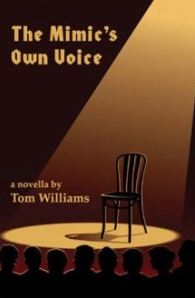
Tom Williams’ novella, The Mimic’s Own Voice, was released in 2011. Williams was kind enough to entertain a few questions of mine in this email interview (conducted in early December 2011). Williams’ story is a quirky consideration of mimicry and biography. And I’m not just saying that because of the kind sentiment he expresses at the start of the interview. As noted in his bio: “A former James Michener Fellow, he has received individual artist fellowships from the Wisconsin Arts Board and the Arkansas Arts Council. He currently is an associate editor of American Book Review” and Department Chair/Professor of English at Morehead State University. My thanks to Williams for his time and thoughts as well as Susan Henderson for helping to arrange this interview.
Tom Williams: Tim, let me first say thanks for agreeing to do this interview. One of the great things about having a small press book is that I’ve been required, pretty much, to do a lot of my own publicity. Yet I get to meet (in this virtual way) people like yourself, who do so much for writers and, it seems to me, receive so little in return. I hope I don’t stumble too much over these great questions.
Tim O’Shea: In developing this story, how early did you realize it was best suited as a novella, as opposed to a novel or short story?
Williams: As evidence of my unerring commercial intuition, I knew almost right away that it was a novella. The opening lines had a certain kind of tone and were pointing toward an almost historic sweep. I thought for a time it might be a novel but sensed the appropriate length was short of novel length after I had gone through, for the first time, my comedy history-from the one liner royalty to the vernacular story tellers to the mimics to the social critics to, finally, the observational comics. To flesh it out too much would, I thought, ruin the joke, and to try to bring it in under 30 pages would leave too much out.
O’Shea: In this Creative Loafing review, it is written: “Despite the layers of voices and styles, nothing about this book feels pastiche-ey or cobbled-together. Williams expertly subordinates each to the larger narrative, the academic story of Douglas Myles, and incorporates his source material smoothly into something more like a quilt than a collage, or like an onion.” How frustrating or taxing was it to build your narrative with the layers of voices and styles?
Williams: I’m having a conversation via email with another fiction writer, John Warner, whose debut novel, The Funny Man, shares many of the same themes and obsessions as The Mimic’s Own Voice, and one thing that he said that intrigued me was that in his own writing he needed to find ways to keep himself interested in the story. I went through a similar process. In trying to utilize all those voices and texts (I invented newspapers, journals, TV shows, all sorts of things for this purpose) in one narrative I was challenging myself and it became one of the joys of coming back to the manuscript every day. I can remember distinctly one morning inventing one of the critics, Melissa Tangier, and saying, “Oh man, she’s biracial, too,” and working to figure out where her lines would come in and blend with the other critics and the voice of the narrator. Seriously, though, I don’t think it would be the book it is without that element of multiple voices. That review,too, that you cite, by Jason Cook, is one that I think really gets at a lot of the crucial matters of the book, which is really heartening, knowing some people might have gotten what I was up to.
O’Shea: How important was it for the fuel/drive of the story that the lead character be “the only child of Angela and Ellis Myles, a black mother and white father“. And when I ask that question, I not only mean the racial aspect, but the element of being an only child?
Williams: You’re one of the first people to highlight the only child aspect of Douglas’s life, Tim, and I can’t stress enough how important I thought that was. Because I’m biracial, many people wondered how much of Douglas’s story has parallels with mine, and while I won’t say we are without similarities, what really helped make him the character I finally started to work with was his being an only child-unlike me. Had he any siblings, he wouldn’t have become a mimic, he wouldn’t have become the person he is, as he would have had somebody enough like him to identify with. As it is, when he’s finally orphaned and wholly alone, it’s as if he identifies with everyone else and never really, as we used to say, finds himself-though he’s one of the most famous people in the world.
O’Shea: In developing the novella, how much did you research the craft of being a mimic?
Williams: I hope this doesn’t disappoint, but virtually none. For one, there isn’t a whole lot, I’ve since discovered, to research. Mimicry seems one of those skills that people have or don’t have. I’m an okay mimic myself, but I’m out of practice and I was never up to the level Douglas Myles is. With him, I tried to imagine what it would be like if I could find in everyone’s voice something to reproduce and let it go from there. This lack of research might explain why I also left out in Douglas’s manuscript any of the techniques of mimicry. I feel kind of like a fraud now. Thanks, Tim.
O’Shea: How intrigued were you to read this analysis, which juxtaposed you work with Phong Nguyen’s Memory Sickness?
Williams: Speaking of great reviewers, John Stazinski couldn’t have written a better review if I had invented him. As well, in passing, he compared me to Sartre, Camus and Ellison, who belong to a club where I won’t even be invited to to clean the bathrooms. Moreover, I liked that my book shared space with Phong’s incredible collection. I don’t think his stories in that particular collection confront head on as much the issue of biracial identity, but his sensibility, shaped by being biracial, too, is very similar to mine. It’s that sense of being in-between, having connections with but never completely, to different cultures and experiences. I don’t want to speak for Phong, but as a biracial man, I’ve always felt like a spy without allegiances, bouncing between two warring nations.
He and I, along with some other first book authors, are going to read at Barbara’s Bookstore in Chicago during the Association of Writers and Writing Programs Conference [which was held in February 2012]. Should be a good time.
O’Shea: I’m curious, given that the novella is dedicated to your mother, do you agree with this writer’s assessment: “He keeps the memory of his mother alive in Myles’ beautifully written character.”
Williams: That is a wonderful sentiment, one that makes me wish I were the writer this person thinks I am, but in truth the book was finished long before my mother died. At the risk of sounding totally sentimental, I had always known that I would dedicate my first book to my parents. When I got the notice from Main Street Rag that they wanted to publish The Mimic’s Own Voice it was September and she’d died that May.
But in a way, Douglas Myles’s whole need to mimic stemmed from a need to keep people’s voices alive, even when the people themselves were no more. And of course this is, to me, the tragedy of the book, of Douglas’s art (if you want to call mimicry art)-that art can console but not quite heal. Yet what would we do without it?
This reminds me, too, that I need to get to work because I owe my dad a dedication. And my wife. And my son. And all the teachers who helped me to get where I am now.
O’Shea: Given the complexity of the novella, how much revision and editing (and how long as process) did it take you to get it completed?
Williams: I’ve shared this before in interviews, that , for one, I finished it so long ago, I’m wondering whether I’m inventing another fiction when I talk about its composition. But in truth it was such a joy to draft that I remember finishing the first version very quickly. A couple of months, perhaps. It was called at that time the Impressionist’s Own Voice, which sounds incredibly clumsy now yet the only reason I changed it was because a visit to Books A Million in 2003 shoved in my face some copies of Hari Kunzru’s novel The Impressionist.
Revision didn’t take all that long either. A month or two. I worked, as I tend to do, exclusively on this. Douglas Myles really consumed me. I wanted his world to be as amazing as he was and literally seven days a week I tried to make that happen.
The real story is how long the book sat, unpublished and nearly forgotten by its author. I am pretty sure the earliest completed version of it was part of a collection of stories I sent out in the summer of 2003; obviously, it didn’t get published. (Though the press, I point out with no glee, is no longer, so I got lucky by their rejection.) I sent that collection out to some contests, and tried too with some novella contests-no luck. I even sent out the novella to an online journal that specializes in longer works. Again, same story. That Scott Douglass (it just occurred to me that he has nearly the same last name as my central character’s first name) of Main Street Rag asked me if I had a novella to submit to their nascent novella series, and that he and Craig Renfroe said yes to it still strikes me as the most unlikely of dreams coming true.
O’Shea: Anything you’d like to discuss that I neglected to ask you about?
Williams: One thing that I have yet to hear about in the reviews and responses The Mimic’s Own Voice has generated is a discussion about the anonymous scholar narrator. John Stazinski gets it right that the narrator, in the world of the novella, is a “Comedic Studies scholar” but to my knowledge, no one has commented much on him. And to me he’s as much a mimic as Douglas, as any young scholar or even student who has to go through the paces of speaking with a bunch of others voices to speak for his point of view. That’s another thing I love about John’s review: He speaks of how the book turns on the idea of the notion of how all of us are nothing like a stable or consistent self but instead a “pastiche of voices.” But while I’m not saying that we’re all mimics, I am, or at least I thought I was, through both Douglas and the narrator, trying to have fun while exploring the notion of trying to find one’s voice through the use of other’s voices. I’m still trying to find my own, to be quite honest.
Thanks again, Tim. This was a blast.