Back in October, I expressed admiration for Allstate’s Mayhem commercial branding.
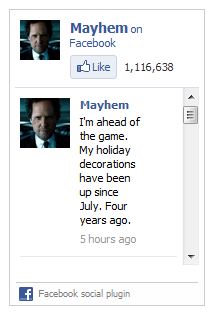
But today, I got contacted by the fine marketing folks at Allstate, who clearly appreciated my post. But they also wanted to make me aware that while I linked to the Allstate Mayhem YouTube page, I overlooked Allstate’s main Mayhem page, which is pretty engaging in its own right-as it provides links to the videos and Mayhem’s equally funny Facebook posts.
My thanks to Allstate for the comedy and for making me aware of the page. Enjoy.
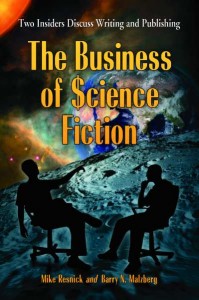
Normally I try to incorporate the interview subject’s latest project in the interview headlines, but Mike Resnick has so many books on the cusp of being released (or already released) that I did not want to focus upon only one. This email interview covers a wide range of books, including The Business of Science Fiction: Two Insiders Discuss Writing and Publishing (Set to be released on March 6); The Buntline Special (Pyr) and Blasphemy-as well as a variety of other topics. My thanks to Resnick for his time and to Kevin J. Anderson for putting me in contact with Resnick.
Tim O’Shea: When you and Barry Malzberg started collaborating on columns a number of years ago, did you ever envision it could grow into a full fledged book?
Mike Resnick: It wasn’t why we began the column, but once I saw that it was popular and continuing, yes, I always assumed there’d be a book.
O’Shea: Are there any central ways that you hope readers benefit from The Business of Science Fiction? Are there certain books that helped you when you were first starting out as a writer or were the lessons you learned something that had to be experienced firsthand-not in a book?
Resnick: We’ve got a combined 90 years in the field, we’ve each written or edited over 100 books, we’ve each edited science fiction magazines, I’ve been a publisher, Barry has worked for an agent…there’s simply nothing we haven’t seen, no scam we can’t describe, and we’re secure enough at this point in our careers that no one’s likely to blackball us for letting unpleasant truths out of the closet.
Before today, I’ll be honest and admit I had never read the critical analysis of Philip Bump. But after reading his brief consideration of the past decade in logos, I will be sure to read him increasingly more going forward. One of Bump’s valid points in evaluating logos of the past is:
“The web, in essence, is the photo album brought out to show what a logo looked like in its awkward phase – and for that, it should be praised.”
I also greatly appreciate this post by Bump, because it introduced me to Logo RIP, a virtual graveyard for discarded commercial logos.
In the past few months, while researching for this site’s various interviews, I’ve found Kosmix to be quite effective in providing me with a great deal of background for questions. Curious to learn more about the helpful web presence, I contacted its staff for an email interview. They were quite open to the idea and put me in contact with Kosmix Co-Founder Venky Harinarayan. Here’s the official bio for Harinarayan from Kosmix: “Venky Harinarayan and his business partner Anand Rajaraman co-founded Kosmix in 2005 with the vision to connect people to the information that makes a difference in their lives. Together with Anand, Venky developed the first ecommerce search engine, Junglee, which was acquired by Amazon.com in 1998 for $250 million. At Amazon, Venky and Anand created the company’s search and marketplace business. In addition to Kosmix, Venky is a principal at Cambrian Ventures, an early-stage venture capital firm. He is a graduate of Stanford University and the Indian Institute of Technology.” Regular readers know I typically run my interviews on late Wednesday evenings, but I so enjoyed the amount of ground we covered with this particular exchange, I opted to post it a day early. My thanks to Harinarayan for his time.
Tim O’Shea: Recently at the Kosmix blog, there was a mention of Sean Parker’s October speech, where one of his points about the future of the Internet was “Parker argues that the next phase is about building connections between people and things.” Is Kosmix’s acquisition of Cruxlux an effort to do just that-build stronger connections between people and things?
Venky Harinarayan: Absolutely. At Kosmix, our mission is to connect people to the information that makes a difference in their lives. Our acquisition of Cruxlux fits perfectly with that vision.
In the early days, the Internet was about finding information, not about connecting people. Now with the advent of sites like Facebook and Twitter, the Web has an amazing capacity to illuminate social networks. Interacting with other people has moved to the forefront our online activities. The next step will be to connect people with information that matters to them—without you having to search for it.
We’ve made progress in this area with www.Meehive.com, our personalized news site. You tell MeeHive your interests, and then the system scours millions of news outlets and blogs to bring you fresh stories about the people and things you want to follow. For example, if you’re passionate about Broadway theatre, MeeHive will let you know every time there’s a review of a new musical, or breaking news about your favorite playwright’s latest work. Facebook is about what you’re up to, and Kosmix and MeeHive are about what you’re into.
Dalton Trumbo testifying before HUAC in 1947 (Library of Congress/World-Telegram photo)
Growing up in the 1970s, I knew nothing about the U.S. House Committee on Un-American Activities (to get a glimpse of this government committee’s impact, be sure to examine Google’s timeline on this organization from 1938 to 1975)-or more specifically I knew nothing about the Hollywood Blacklist. Fortunately, as I grew older, I learned a great deal about this recent dark portion of U.S. history. Sometimes when I hear some talk radio and much of the cable news channels (either side of the political spectrum), I wonder if we’re on the cusp of another age of blacklisting. I hope not.
Thanks to researcher and author Jeff Kisseloff, there is now a website that provides documents related to the days of blacklisting. I first became aware of Kisseloff’s blog, thanks to Mark Evanier who knew about it because of Aaron Barnhart. Kisseloff does not just provide links to blacklisting-related documentation, he covers a range of topics, as varied as the topics he addresses in the books he writes (a list of which can be found here).
What’s great about Kisseloff’s approach to blogging is, as an established non-fiction author, rather than rehashing old ground covered in his books with the blog, he gives a glimpse of life while he was researching and writing a certain book. (That’s not how he approaches every blog post, he covers a range of topics in unique ways) In the case of this post, Kisseloff juxtaposes the lives of a CBS TV executive, Frank Stanton, and Allan Sloane, a writer negatively impacted by the blacklist. Plus Kisseloff tosses in a link to the CBS loyalty oath.
Once I update the blogroll, likely over the holidays, I’ll be adding The Kisseloff Collection to it.
This Wednesday, legendary journalist and novelist Pete Hamill will speak as part of the The Rosamond Gifford Lecture Series in Syracuse, New York. As noted at its Facebook page, the series is “the largest library-related lecture series in the country”. That’s one heck of a claim.
In preparation for the upcoming speech, Mark Bialczak of The Post-Standard interviewed Hamill. It covers a great deal of ground and is well worth your time reading. (Hat tip to Poynter’s Romenesko for the link)
I am hard pressed to find one quote that stands out, but here’s a snippet of one great exchange in the interview:
What can news organizations, media organizations, do to help keep consumer interest in words and images survive, not just videos and links?
I think they have to begin in high school. They have to somehow find ways to convince teachers that they have to turn their students onto real news sites, not TMZ, where you find celebrity stuff, not the endless life and times of Jon Gosselin, whoever the hell he is.
Hamill has an insightful perspective on the newspaper industry.
Warning to folks who might be reading this post via my Facebook notes feed and/or at work, this post is definitely an adult topic. If you prefer not to read about sex workers, Las Vegas, commerce and the intersection of all of three factors, please read no further.
Sexuality and commerce are intertwined in numerous wacky, and yet, fascinating ways. Laurenn McCubbin grasps that reality better than most. So when she recently contacted me (and several of her other many, many Facebook pals) about an upcoming performance and art installation she is raising funds for, I was curious. I’m not asking you (in tight economic times) to fund this project, but I do want to make readers aware of it-in case it is something you would like to support-be it fiscally or, for those of us on tight budgets, by spreading the word about the project (as I am doing). As performance and art installations go, I have to give McCubbin credit for her creative take with this particular topic.
This post, beyond this paragraph, is definitely not safe for work by many company’s standards. For young readers of this blog or folks who do not want to look at this, I place the main info after the jump.
So tonight I was at my mother’s house, looking for something that required me to dive into the folder of stuff my parents keep in a file for me (honor roll notices from grade school, summer reading program certificates from the 1970s…amazing stuff).
And then, in the file, I found a few of these. Tickets sent to me, due to my good grades (I’m fairly certain I was not a straight A student). As a kid, I did not appreciate the printed signature on the certificate (yep, that’s Ted Turner). The logo was WTBS on the eve of Turner Time (remember when TBS shows started at 5 minutes after the hour or half hour)-before the days of TBS Superstation.
Holding these tickets took me back to my childhood. Back in the days when the Braves were managed by Bobby Cox on his first round with the team (his second to last year as manager on this round)-but far from first place. It’s funny, as a kid I remembered them as always being a last place team, but as documented by Wikipedia, there were two teams (San Francisco Giants and San Diego Padres) worse off than the Braves.
[Apologies for the fuzzy quality of the image, O’Shea mansion does not have a readily available scanner, so I shot this with my wife’s Blackberry…]
In the introduction to her book, Slanted and Enchanted: The Evolution of Indie Culture, Kaya Oakes writes: “If we understand culture to mean something more than a style of music, a visual aesthetic, or a literary mode and try to define it from its Latin root, cultura—“to cultivate”— then we can see how indie artists have traditionally worked together to cultivate many things: credibility, freedom, the ability to promote their own work and to control how it’s promoted, self-reliance, open-mindedness, and the freedom to take creative risks. Likewise, if a culture is truly a group of people working and living together, independent artists have traditionally embraced the value of networking, making connections, and striving toward doing their art, their way. If being independent in your choices about what you listen to, look at, read, and watch implies a lack of compromise, then many of the people still making music and art independently would absolutely fit that definition. Indie’s ambiguity can partially be chalked up to its emphasis on making its participants feel individual and unique. But before any of us were able to be creatively independent, we had to build on the practice of our independent predecessors. Because indie’s history is in many ways a shadow history— one that parallels and reflects mainstream culture but also poises itself as being a subculture of outsiders— the threads connecting the twentieth- and twenty- first-century indie movements are not always readily apparent, especially in this day and age, wherein young artists face a plethora of choices about what kind of art they will make and how to distribute that art. Young fans often encounter art that builds on traditions of independence with which they may not be familiar.” (The entire intro can be read here at Oakes’ site). In the book, Oakes (who co-founded Kitchen Sink magazine) set out to examine the evolution of the indie movement and the scope of its impact. My thanks to Oakes for her time and insight into the DIY dynamics.
It seems like media industries are being redefined on a fairly frequent basis these days. So when I found out about the new textbook, Media Industries: History, Theory and Method, I was curious to see what ground the textbook covered. Fortunately, the editors of the textbook, Jennifer Holt (Assistant Professor of film and media studies at the University of California, Santa Barbara) and Alisa Perren (Assistant Professor in the Department of Communication at Georgia State University) were quite willing to answer my questions. In the spirit of the collaborative way that they edited the textbook, Holt and Perren collaborated on the answers. Once you’ve read the interview, be sure to also visit Professor Perren’s media industries blog. My thanks to both Holt and Perren for the interview. And if that’s not enough for you, be sure to visit Wiley’s (the publisher’s) site to download a PDF excerpt of the textbook.
Tim O’Shea: How did the idea for the textbook first come about?
Jennifer Holt/Alisa Perren: We both teach classes about the media industries and were frustrated with the lack of course materials devoted to this subject – especially materials approaching the topic from a humanistic perspective. We also saw that the study of media industries had been growing and expanding but it had not yet been mapped as a field in an academic text. So we enlisted some of the people who have done formative work in this area as well as those doing new scholarship to help us put what we saw as the emerging field of media industries into context for our readers. (To view the book’s table of contents, click here.)
O’Shea: How did you divvy up the editorial duties on the textbook?
Holt/Perren: This was truly a collaborative effort. We worked together in recruiting contributors, editing all of the essays, and writing the introduction. And amazingly, we remained friends through it all.




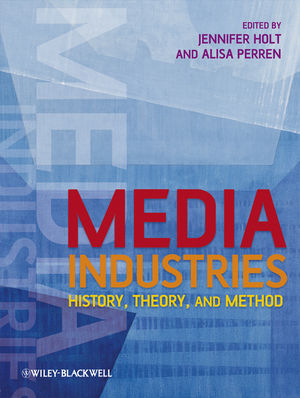 It seems like media industries are being redefined on a fairly frequent basis these days. So when I found out about the new textbook, Media Industries: History, Theory and Method, I was curious to see what ground the textbook covered. Fortunately, the editors of the textbook, Jennifer Holt (Assistant Professor of film and media studies at the University of California, Santa Barbara) and Alisa Perren (Assistant Professor in the Department of Communication at Georgia State University) were quite willing to answer my questions. In the spirit of the collaborative way that they edited the textbook, Holt and Perren collaborated on the answers. Once you’ve read the interview, be sure to also visit Professor Perren’s media industries blog. My thanks to both Holt and Perren for the interview. And if that’s not enough for you, be sure to visit Wiley’s (the publisher’s) site to download a