As promised, here is the direct link to Everyartist’s Kickstarter, which has launched.
Before you donate to the Kickstarter, you will likely ask-where is my money going to be utilized? Here’s the plan:
“In 2013, Everyartist will create a national, collaborative art event that engages elementary school children across the country – the largest art event in history.
We’re raising money to launch and facilitate this national collaborative art event. Included in this is building a downloadable kit that will make it easy for parents and teachers to register and become local event coordinators. The kit includes instructions for staging an event, group lesson plans with the rudimentary elements of drawing designed by a professional art educator adaptable to every age group, stickers and other incentives for the participating children, and a press release that can be shared with local media.
We can bootstrap this event for $30,000, but the more money we raise, the greater our impact will be and the more kids we can reach. We need your support!”
There are few cultural obsessions that annoy me more than the public’s fascination with finding out the so-called truth about the JFK Assassination. Was the event a tragedy? You bet. But a sure fire way to get me to flip a channel is to be a documentary about the event. There’s only one person that could get me to watch a JFK Assassination-related documentary: Errol Morris. Damn you, New York Times, you sucked me in with this OpDoc.
Here’s hoping Morris dedicates himself to a larger related project on the subject. In the interim, I could watch Tink Thompson tell stories all day long. The man can work a camera.
To hear Kevin Clash’s natural voice, it’s amazing he’s Elmo. When I hear Frank Oz’s natural voice, I always hear Fozzie the Bear. Not so much with Clash. Here, thanks to the Archive of American Television, he talks about the development of the character.
Several weeks back, while listening to a podcast of Tony Kornheiser‘s radio show on ESPN 980 , I heard Kornheiser talk to Washington Post sports reporter Kathy Orton discussing her new book, Outside the Limelight: Basketball in the Ivy League. Two topics like academics and sports intersecting caught my attention immediately. I was fortunate enough to get in contact with Orton and email interview her about the book. Before jumping into the interview, here’s the basic info on the book: “The Ivy League is a place where basketball is neither a pastime nor a profession. Instead, it inspires true passion among players, coaches, and fans who share in its every success and setback. Outside the Limelight is the first book to look inside Ivy League basketball at what makes it unique.”
Tim O’Shea: How different is the recruiting process for players in the Ivy League-do the coaches find themselves needing to focus more upon the academics of their students in terms of finding good recruits?
Kathy Orton: While it is a challenge for Ivy League coaches to find good students with equally good jump shots, I believe the more difficult hurdle for the coaches is finding players with those attributes who also can afford an Ivy League school. It can cost upward of $50,000 a year to attend one of these schools. Because of the costs associated with these schools – remember there is no athletic scholarships in the Ivy League – many middle class kids (and their parents) just can’t justify paying that much money to play basketball when they can go for free to another school. The economic aspects limit the recruiting pool far more than the academic standards.
O’Shea: Given that these Ivy League athletes feel the need to excel as much in the classroom as well much as on the court, what kind of stress level are they under during the season?
Orton: I didn’t fully appreciate the demands on an Ivy League basketball player until I started reporting the book. To begin with, Ivy League schools are extremely competitive, pressure-filled environments for all students. Throw in a Division I sport such as basketball, where you spend close to five hours a day in a gym practicing, watch game film and lifting weights, not to mention the travel to away games (on busses, not charter airplanes), and there’s not a lot of time left over for sleep. I find these kids amazing, and studies have shown because of how they have to excel at time management during college they tend to do better than their peers once they leave school.
It seems like media industries are being redefined on a fairly frequent basis these days. So when I found out about the new textbook, Media Industries: History, Theory and Method, I was curious to see what ground the textbook covered. Fortunately, the editors of the textbook, Jennifer Holt (Assistant Professor of film and media studies at the University of California, Santa Barbara) and Alisa Perren (Assistant Professor in the Department of Communication at Georgia State University) were quite willing to answer my questions. In the spirit of the collaborative way that they edited the textbook, Holt and Perren collaborated on the answers. Once you’ve read the interview, be sure to also visit Professor Perren’s media industries blog. My thanks to both Holt and Perren for the interview. And if that’s not enough for you, be sure to visit Wiley’s (the publisher’s) site to download a PDF excerpt of the textbook.
Tim O’Shea: How did the idea for the textbook first come about?
Jennifer Holt/Alisa Perren: We both teach classes about the media industries and were frustrated with the lack of course materials devoted to this subject – especially materials approaching the topic from a humanistic perspective. We also saw that the study of media industries had been growing and expanding but it had not yet been mapped as a field in an academic text. So we enlisted some of the people who have done formative work in this area as well as those doing new scholarship to help us put what we saw as the emerging field of media industries into context for our readers. (To view the book’s table of contents, click here.)
O’Shea: How did you divvy up the editorial duties on the textbook?
Holt/Perren: This was truly a collaborative effort. We worked together in recruiting contributors, editing all of the essays, and writing the introduction. And amazingly, we remained friends through it all.
When I interview folks, I periodically like to follow-up and get suggestions for other people they think I should interview. That’s how I landed an interview with Zak Champagne, a fellow music nut (in a good way) and a fourth grade math teacher at Mandarin Oaks Elementary School in Jacksonville, Florida. Shelby Miller of the Shifted Sound podcast recommended that I pick Champagne’s brain for his thoughts on teaching math and enjoying music. My thanks to Champagne for his time and Miller for the suggestion.
Tim O’Shea: What attracted you to teaching in the first place and math in particular?
Zak Champagne: First and foremost, I was going to be a rock star. Teaching wasn’t really in the plans until college. You see I had everything ready for rock superstardom except for the talent of playing or singing music. Now I was in a band…but we were much more into the superficial things about being in a band rather than actually being a band. But…I sort of knew towards the end of high school that I wanted to teach. Once I got into college (University of North Florida) I thought I wanted to teach high school. It seemed rather logical to me. But while I was preparing to become a teacher, I took a job at a youth center here in town and ended up working with K-2nd grade students. And it was during that time I had found my calling.
Now the math thing is a bit more interesting. Once in elementary school I saw a need to make mathematics meaningful to my students. I encountered so many young students who already hated mathematics. And to me that was not okay. I have to find a way to inspire my students to love mathematics for what it is. And I found one of the best ways to do that is to make it meaningful and fun.

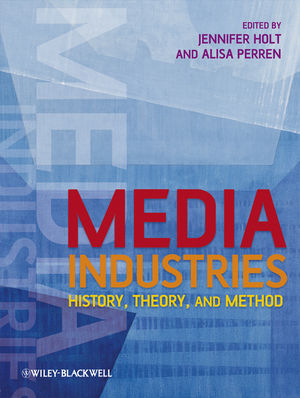 It seems like media industries are being redefined on a fairly frequent basis these days. So when I found out about the new textbook, Media Industries: History, Theory and Method, I was curious to see what ground the textbook covered. Fortunately, the editors of the textbook, Jennifer Holt (Assistant Professor of film and media studies at the University of California, Santa Barbara) and Alisa Perren (Assistant Professor in the Department of Communication at Georgia State University) were quite willing to answer my questions. In the spirit of the collaborative way that they edited the textbook, Holt and Perren collaborated on the answers. Once you’ve read the interview, be sure to also visit Professor Perren’s media industries blog. My thanks to both Holt and Perren for the interview. And if that’s not enough for you, be sure to visit Wiley’s (the publisher’s) site to download a