Archive for category nonfiction
Stephen Battaglio on Election Night: A Television History 1948-2012
Posted by admin in nonfiction, politics on January 30, 2013

Election Night: A Television History 1948 - 2012
In November 2012, the United States elected a president. Also right around the same time, author Stephen Battaglio released his latest book, an e-book to be exact, Election Night: A Television History 1948-2012. As described by the publisher, the book “is a fascinating and revealing look at the evolution of U.S. presidential election night broadcasts and how since 1948, this televised event galvanizes the nation. It explores the technical advancements in vote counting, live coverage from the field, how the networks get polling information and call a state for a candidate and how the drama unfolds in the control room. Through the lens of NBC News, Election Night highlights significant commentary by legendary news figures such as Chet Huntley, David Brinkley, John Chancellor, Tom Brokaw, Tim Russert, and Brian Williams.”
The book makes the most of the Kindle platform, utilizing the NBC large video archives, as well as offering historical audio clips in an enhanced edition [available here [or iTunes link here]. To find out more about his latest project, Battaglio accepted my invitation for another interview (I first interviewed him in 2011 regarding his book on NBC Today Show’s 60-year history.)
Tim O’Shea: You pull data for the book, including congressional hearings as well as the David Brinkley Papers/Archives. What was the biggest surprise/most interesting aspect of delving into Brinkley’s papers?
Stephen Battaglio: I loved David Brinkley. He is my favorite TV news anchor of all time. The humor that he managed to inject in his on-air commentary came across in his papers, especially in personal letters and internal memos. What you saw on screen was his true self.
Speech: Brad Meltzer on How To Write Your Own Obit
Posted by admin in biography, ideas, nonfiction, pop culture, streaming video on October 13, 2011
Obituaries have always fascinated me, for the stories they tell.
So when pal of the blog, award-winning novelist and host of History Channel’s Decoded, Brad Meltzer, sent me a link to his new TEDxMIA speech, How To Write Your Own Obituary, I clicked on it immediately.
As with most things Meltzer, it’s worthwhile viewing.
Impressive TV Show Pitch: Early Innings
Posted by admin in nonfiction, sports on June 11, 2011
I don’t often check out the videos on Vimeo, and after my latest discovery I feel foolish for that oversight. After recently watching a quirky Vimeo video (sent to me by a friend), I started looking around at other videos on the site. That’s how I discovered Early Innings, a TV pitch created by David Targan and Cinematography & Editing by Rod Blackhurst.
As detailed in the pitch, “In Early Innings we’ll experience the ride of a minor league baseball season with the people whose lives are inextricably bound by America’s Pastime … In year one we’ll follow the Burlington Bees at the lowest level of the minor leagues – Lo-A … Early Innings will ‘follow’ the Bees for an entire season, as 50 or so players chase the ultimate American Dream.”
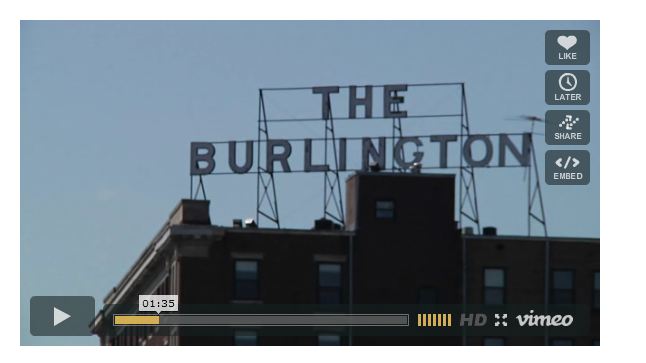
Early Innings
I do not know if this was a pitch for ESPN or MLB, but the insight I gained in this 10-minute pitch made me want to see more. I would love to embed the video here for you to watch it, but Vimeo prevents me from doing that in this case. That’s fine, however, as I think you gain a great deal more insight when you visit Blackhurst‘s website.
RIP: Joseph Wershba
Posted by admin in history, nonfiction, pop culture on May 19, 2011
Joseph Wershba worked with news pioneers Edward R. Murrow and Fred Friendly. Not many people can say they fought Senator Joseph McCarthy so effectively as this man. He died this past weekend and this is just one snippet from a six-hour 1997 interview with him.
Found (circa 2007): TMBG at TED
Posted by admin in ideas, Music, nonfiction, streaming video on January 20, 2011
The other day I realized how much fun I have just linking to videos here at the blog. To think that I can embed video from TED, the nonprofit entity “devoted to Ideas Worth Spreading”. And one morning in 2007, in the early morning no less, one of my favorite bands, They Might Be Giants, appeared at TED. And now I get to share it with you.
Bonus detail: TED offers subtitles with these videos, which is always great with TMBG songs. At the nine-minute mark, they do one of my favorite songs (several songs in one song actually), Fingertips.
End of Year Lists: The Casual Optimist
Posted by admin in comics, criticism, Literature, nonfiction on December 30, 2010
Once again I am indebted to The Second Pass for informing me of multiple “best of” literary lists that I need to reference in the next few weeks.
First up in the lists that caught my eye was The Casual Optimist‘s A Year in Reading 2010. Consider the following nitro (to a sampling of books that included items that may have not been published in 2010 :
“2010 was a year of losing battles and one of the first casualties was time for personal reading. The moments I did have were snatched on the subway and, if I could keep my eyes open, last thing at night. I often found myself unwittingly rereading chapters I had read the previous day, or worse, that very morning. The difficulty this week of compiling a list of my favourite books of the year — and the predictability of that list (to be posted soon) — made it very clear that not only did I read less than previous years, I rarely strayed off the beaten path.”
Anybody that exhibits such a great level of candor is someone I want to pay attention to more in the future.
Sneak Peek: Brad Meltzer’s Decoded
Posted by admin in history, nonfiction, politics, pop culture on November 22, 2010
Friend of the blog/New York Times best-selling author/Guy generally juggling three amazing projects at once Brad Meltzer sent me a link to his new History Channel show, Decoded, which is set to premiere on Thursday, December 2, at 10pm. (Ya gotta love that Brad, fellow child of the 1980s, referenced the old LA Law timeslot when mentioning his show’s timeslot to me.)
Here’s how the History Channel describes the show:
“What if the history you knew was only half the story? Brad Meltzer’s Decoded investigates the other half: the secret history of the symbols and codes that surround us everyday. Best-selling author Brad Meltzer has been writing novels for more than a decade. He has studied and written about some of the most revered institutions and documents in human history, including the U.S. Supreme Court, the Presidency, the Secret Service, Wall Street and the Bible. Brad has assembled a team to investigate the countless clues and theories uncovered through his years of research, but unexplored until now. From the dollar bill to the first Presidential Codes, the hidden messages of the Statue of Liberty and the ciphers protecting the location of lost Confederate gold, the team uncovers the truth behind history’s most provocative secrets.”
The show looks to be an interesting premise, plus I’m jealous that his show is sponsored by Porsche and that the hosts get to drive a Porsche as part of the show. I look forward to seeing it on December 2.
David N. Meyer on Gram Parsons Biography
Posted by admin in biography, Music, nonfiction, Uncategorized on August 25, 2010
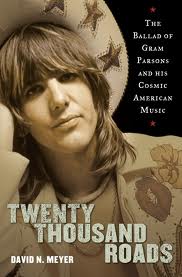
The Ballad of Gram Parsons and His Cosmic American Music
Over the past few years, my increasing interest in Americana music has prompted me to explore its roots. This exploration recently led me to David N. Meyer‘s book, Twenty Thousands Road: The Ballad of Gram Parsons and His Cosmic American Music. As a Georgia native, it surprised me to learn that Parsons spent his earliest years in Waycross, Georgia. But that’s far from the only thing I learned in this engaging book. Meyer was kind enough to discuss the book and his research process in this recent email interview.
Tim O’Shea: In writing about Parsons’ life, considering that his musical career was essentially 10 years, were you surprised you were able to devote 300 pages to that aspect of his life or could you have written more if you had had the time and space (in publishing terms)?
David N. Meyer: I had to be conscious of holding back from writing too much. I found pretty much every detail fascinating, and given how compressed GP’s career was, illuminating as well. And it’s tempting to include every nugget; ask any biographer. So, no, I was not surprised.
O’Shea: Most biographies don’t sport encyclopedias. What motivated you to do one?
Meyer: I imagined a 15-year-old finding this book 15 years from now, and not having any idea who a number of the mentioned musicians, family members and cultural figures were. While ample web resources exist, I wanted to provide context. It’s that completist thing, too. I wanted readers to be able to instantly read and contextualize anyone mentioned in the book. It was also a lot of fun to write.
-
You are currently browsing the archives for the nonfiction category.
 Extended Exposure (Pop Culture Tumblr)
- bad-postcards:
SAMMY RAGSHI THERE.Be sure and watch for me on... September 19, 2015bad-postcards: SAMMY RAGSHI THERE.Be sure and watch for me on T.V. with my famous high unicycle and all the rest of my trick cycles. SEE YOU SOON.SAMMY RAGS
- historicaltimes:
Dr. John Bayard Britton with the .357 Magnum... September 17, 2015historicaltimes: Dr. John Bayard Britton with the .357 Magnum he carried for protection when visiting the Pensacola Ladies’ Centre to perform abortions. He was murdered the following year after this photo was taken by anti-abortion extremist Paul Jennings Hill. 1993. via reddit
- Stills from the Matthew Sweet video Girlfriend September 17, 2015Stills from the Matthew Sweet video Girlfriend
- I miss Phil September 17, 2015I miss Phil
- 20th-century-man:
Katharine Hepburn September 13, 201520th-century-man: Katharine Hepburn
- bad-postcards:
SAMMY RAGSHI THERE.Be sure and watch for me on... September 19, 2015