Posts Tagged film interview
Jeremy Newberger on Évocateur: The Morton Downey Jr. Movie
Posted by admin in pop culture, talk show on April 5, 2012
When I found out that the folks over at Ironbound Films had made Évocateur: The Morton Downey Jr. Movie, a documentary about one of the most unique television hosts from the 1980s, I was intrigued. Then when I learned the documentary was going to have its world premiere this month at the Tribeca Film Festival, I was fortunate enough to email interview one of the three creative forces (and directors) from Ironbound, Jeremy Newberger.
Tim O’Shea: Was it hard to track down folks that had worked on the production of his show, or are many of them still active in the industry today?
Jeremy Newberger: Finding the producers of “The Morton Downey Jr. Show” was easy. Getting them to overlook twenty years of repressed rage and therapy bills was a little trickier. Most of them are still in production on everything from theSPEED Network to “The Ellen DeGeneres Show.” Show creator Bob Pittman is now CEO of a little company called Clear Channel.
Kevin Avery on The Life and Writings of Paul Nelson and Conversations with Clint
Article first published as Kevin Avery on The Life and Writings of Paul Nelson on Technorati.

The Life and Writings of Paul Nelson
From the 1960s to the early 1980s, Paul Nelson was known for writing passionate, insightful criticism of folk and rock music that showed a partiality for singer-songwriters. He, and his record collection, was of great importance to Bob Dylan early in his career. As an editor at Rolling Stone, he influenced many great critics, such as Charles M. Young and Mikal Gilmore. But suddenly, in the early 1980s, when editorial decisions at Rolling Stone ran contrary to his thinking, Nelson walked away from music criticism. In fact, he dropped out of criticism entirely, choosing to spend his remaining years in relative obscurity, working at a video rental store. He died in 2006, but not before writer Kevin Avery contacted him about a potential biography. After Nelson’s death, Avery was tapped to compile this new Fantagraphics book, Everything Is An Afterthought: The Life And Writings Of Paul Nelson, in which Avery documented Nelson’s career as well as collecting his writing. In addition to discussing this book, Avery also discussed his other Nelson-related book that he edited, Conversations with Clint: Paul Nelson’s Lost Interviews with Clint Eastwood, 1979-1983 (Continuum Books). To mark the release of both books, Avery recently allowed me to interview him via email.
Not to toss a large question your way, but how did Paul Nelson help to shape present day rock criticism?
I’m probably the wrong person to ask. As a result of immersing myself in the music and criticism of the Seventies and Eighties, I really don’t follow rock criticism much anymore, but what I do read bears very little resemblance to the kind of writing that Paul did. Paul’s writing was more contemplative and expansive—in contrast to some of what I read today, which is dictated by time and space constraints (some of the very things that brought Paul’s tenure at Rolling Stone to an end in 1982).
Actress-Producer Camille Mana
Article first published as An Interview with Actress-Producer Camille Mana on Blogcritics.

Camille Mana
October is going to be a busy month for actress-producer Camille Mana. First up, she has a supporting role in the feature film Norman, which opens in theatres on October 21. She plays Helen Black, a unique high school classmate who has a crush on Norman (played by Cougar Town‘s Dan Byrd). Secondly, she will appear in actor/playwright Jesse Eisenberg’s new Off-Broadway play Asuncion, which opens October 27 at the historic Cherry Lane Theatre (directed by Kip Fagan and produced by The Rattlestick). To mark the launch of these two latest projects, Mana was kind enough to do an email interview, where we also discuss her plans for new projects allowing her to pursue additional writer-producer opportunities as well as her additional upcoming film releases.
How many pages did you get into Talton Wingate’s script for Norman before you realized you wanted the role of Helen Black?
I’d say that within the first 5 to 10 pages, I knew I would love to be a part of the project. I think you always know within the first 10 pages if you’re attracted to a piece. Just like first impressions in life- you know early on whether or not you’re hooked on something. All good screenplays establish tone and the world of the story in their opening beats. I remember writing my agents, saying I loved the screenplay, because this is exactly the kind of movie that I love to watch!
Kent Moran on Listen to Your Heart
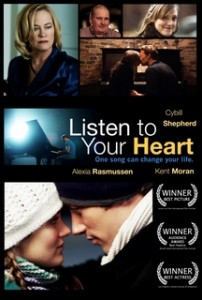
Listen to Your Heart
Article first published as Screenwriter/Musician/Actor Kent Moran Talks About Listen To Your Heart on Blogcritics.
This past Sunday, April 24, the Lifetime Movie Network premiered Listen To Your Heart, a film about an aspiring musician falling in love with a sheltered, hearing-impaired woman in New York-and the complexities involved with that relationship. The film will be replayed this Friday, April 29, at 2 PM EST (as well as Monday, May 9, at 8 PM EST and Tuesday, May 10, at 12 AM EST). The film stars Kent Moran, who also served as producer/screenwriter/composer/second unit director, as well as agreeing to discuss the film in this new email interview. In addition to discussing the many aspects of the film he was a part of, we also discuss the film’s success at numerous film festivals, its popularity on Netflix (Average of 106,997 ratings: 3.9 stars [as of April 21]) and working with a talented cast that included Cybill Shepherd. My thanks to Moran for his time and thoughts, as well as to Joy Phillips for helping arrange the interview.
Tim O’Shea: You wrote the music for the film, I am curious, did you develop the music after you wrote the plot? Or were they developed in parallel? I think part of the movie’s appeal is how well the script and music compliment each other.
Kent Moran: Thank you. Most of the songs I wrote specifically for the film and I wrote them into the script. I knew when I wanted songs to happen in the film. Some songs I wrote while I was writing the script and others I wrote after and then plugged them in. Still Worth Fighting was a song I had written before the movie and then realized that it fit well. Fight For You was originally written as a different song to be played when Danny interrupts the dinner party that Ariana’s mother throws for her, but after the film was edited, I decided that it didn’t work there and re-wrote it, slowed it down, and put it over the later montage where it now plays.
 Twitter RSS
- talkingwithtim: Listening to #LevonHelm sing The Night They Drove Old Dixie Down on @KBCS http://t.co/8oQMMHDo
- talkingwithtim: @BillWillingham @chris_roberson That statement reminds me of the word problems that stumped me as a kid #YeahIAmLousyAtMath
- talkingwithtim: RT @iaanhughes: Tonight on Road Songs the music of Levon Helm @KBCS 9 pm - 11 pm. #Levonhelm
- talkingwithtim: @chris_roberson I thought @allisontype was the queen of all things good (an umbrella which travel, of course, falls under)
- talkingwithtim: @CharlesSoule Greatly regret never getting to see him live #ButWeWillAlwaysHaveHisGreatMusic
Recent Comments