Posts Tagged history
Amy H. Sturgis on The Intersection of Fantasy & Native America
Posted by admin in Literature on December 2, 2009

Intersection of Fantasy & Native America
Amy H. Sturgis was one of the first folks I interviewed at this blog. So I was happy to get to interview her again, this time due to the release of The Intersection of Fantasy & Native America: From H.P. Lovecraft to Leslie Marmon Silko (Edited by Amy H. Sturgis and David D. Oberhelman). Sturgis always gives incredibly interesting and insightful answers-as well as being involved in an amazing wide variety of projects. Here’s the official description of this particular project: “A number of contemporary Native American authors incorporate elements of fantasy into their fiction, while several non-Native fantasy authors utilize elements of Native America in their storytelling. Nevertheless, few experts on fantasy consider American Indian works, and few experts on Native American studies explore the fantastic in literature. Now an international, multi-ethnic, and cross-disciplinary group of scholars investigates the meaningful ways in which fantasy and Native America intersect, examining classics by American Indian authors such as Louise Erdrich, Gerald Vizenor, and Leslie Marmon Silko, as well as non-Native fantasists such as H.P. Lovecraft, J.R.R. Tolkien, and J.K. Rowling. Thus these essayists pioneer new ways of thinking about fantasy texts by Native and non-Native authors, and challenge other academics, writers, and readers to do the same.” Now, on with the interview.
Tim O’Shea: Is the target audience for a book like this mainstream, literary scholars or a mixture of both? Why I ask is when I read chapter titles like “Vizenor the Trickster: Postmodernism Versus Terminal Creeds and Cultural Schizophrenia” I get a smidge intellectually intimidated (that’s meant as a compliment, not a slam)…
Amy H. Sturgis: I’m so glad you asked! We went to great pains to make certain this text would be accessible to interested lay readers as well as students and scholars of fantasy and/or Native American literature. Therefore, in each essay the author introduces and explains the books that he or she will discuss, and the essayists also define their terms carefully to avoid jargonism. This is especially important since our contributors come from such a wide range of fields, each of which employs its own unique terminology. In the essay you mention, Tripper Ryder employs some of the terms his subjects use, but he breaks down each of them in a reader-friendly manner before delving into his fascinating analysis of Gerald Vizenor’s fiction. Never fear! This book was designed to be for any and all who are interested in fantasy and Native America.
Peter Morris on His Catcher Book
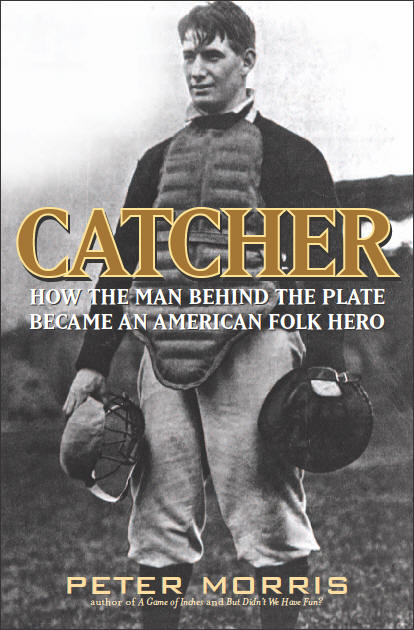 A month or so ago I was reading about Peter Morris‘ knowledge of baseball at The Second Pass. I was curious to learn more from (and about) the baseball historian. So I contacted him to see if he was interested in an email interview. Fortunately, he was and we got a chance to discuss his clear love of the game’s rich past and in particular, his latest book (published in April by Ivan R. Dee), Catcher: How the Man Behind the Plate Became an American Folk Hero.
Tim O’Shea: Given how much you know about the history of baseball, what long dormant rules that used to exist do you think could be re-introduced in the modern era to help revitalize the game?
Peter Morris: What today’s baseball fans rarely realize is that baseball was originally a sport with fast-paced, non-stop action. Catchers snapped the ball back to the pitcher and if the batter stepped out of the box or even looked like he wasn’t paying attention, the pitcher would try to sneak a pitch past him. While every sport has timeouts, only baseball has unlimited timeouts and I think some limit should be put on them. There’s no good reason that a batter should be allowed to step out and take as long as he wants after every pitch. Then you could put and enforce similar restrictions on the pitcher, as well as limiting the number of pickoff throws per at bat.
 Twitter RSS
- talkingwithtim: @camillemana Thanks so much for the interview!
- talkingwithtim: @gabrielhardman @PatchZircher It is streaming on Netflix Instant presently. I have added it to my list.
- talkingwithtim: @caruhhlineee OK, well hang in there #HaveAGreatWeek #LuvUMeanIt
- talkingwithtim: In this week's @Robot 6 WAYR I praise @galacticquest @Paul_Cornell @GailSimone (among others) http://t.co/0ERNiIB
- talkingwithtim: @caruhhlineee Not sure if this is observational snark, but if it is genuine frustration, do know I care
Recent Comments