Posts Tagged Kindle
Hal Duncan on His Fiction, Other Creative Pursuits
Posted by admin in branding, Film, Literature, Music, philosophy, poetry, theater on August 18, 2010

Hal Duncan
I always appreciate when a friend of the blog broadens my area of knowledge by suggesting an interview subject. This week, thanks to a suggestion from Allison Baker (of MonkeyBrain Books), I present my interview with self-described strange fiction writer Hal Duncan. Here’s a snippet of Duncan‘s bio: “A member of the Glasgow SF Writers Circle, his first novel, VELLUM, won the Spectrum Award and was nominated for the Crawford, the BFS Award and the World Fantasy Award. As well as the sequel, INK, he has published a poetry collection, SONNETS FOR ORPHEUS, a stand-alone novella, ESCAPE FROM HELL!, and various short stories in magazines such as Fantasy, Strange Horizons and Interzone, and anthologies such as NOVA SCOTIA, LOGORRHEA, and PAPER CITIES.” In addition to discussing his theories on fiction as well as his work in general, he and I also discussed a musical recently produced that was written by him-and the experience of writing a screenplay. I always thank folks when they give me the honor of their valuable time, but I have to give Duncan an extra big thanks for the level of detail and consideration he gave to his answers.
Tim O’Shea: Your first novel, Vellum, was translated into several different languages. How much were you involved in that process? Can you think of any country where you were pleasantly surprised to find readers took strongly to the book?
Hal Duncan: With some of the translations I’ve had no involvement at all; with others there’s been a lot of back-and-forth. They’re not the easiest books in the world to translate by a long shot, I know; there’s all manner of poetic techniques, dialect, wordplay, even a mixture of mythical, historical, and alternate-history settings that means passing references could be authentic history or utterly spurious. I regard my translators with a mixture of shame at what I put them through and wonder at the fact they’re tackling it. So if there’s anything I can do to help, I’ll do it. It’s fascinating to see the process anyway.
Kristine Kathryn Rusch on Her Writing
Posted by admin in Literature on September 30, 2009

Diving Into the Wreck
In an effort to make up for a lack of interviews a month or so ago, I will be doubling up weekly interviews for the next couple of weeks. Enjoy and thanks for your patience.
Kristine Kathryn Rusch, as detailed at her website, is “an award-winning mystery, romance, science fiction, and fantasy writer. She has written many novels under various names, including Kristine Grayson for romance, and Kris Nelscott for mystery. Her novels have made the bestseller lists–even in London–and have been published in 14 countries and 13 different languages.
“Her novel, Diving into the Wreck, will be published by Pyr in November. The sixth in her Retrieval Artist series, Duplicate Effort, appeared in February. Her next short story collection, Recovering Apollo 8 and Other Stories, will appear from Golden Gryphon in spring of 2010.” As informative and interesting as her website clearly is (given how much I just quoted it), I was curious to learn more about her via an e-mail interview. My thanks to Kevin J. Anderson for getting me in contact with Rusch, and even more thanks to Rusch herself for her valuable time.
Tim O’Shea: What can tell folks about your new short story, “Flower Fairies,” which just appeared in the new issue of Realms of Fantasy?
Kristine Kathryn Rusch: I usually let the stories speak for themselves. So I hope people enjoy it!
O’Shea: From 2000 to the mid-2000s, you wrote several books under the pseudonyms “Kris Nelscott” and “Kristine Grayson”. Also you and your husband (Dean Wesley Smith) wrote under the name “Sandy Schofield” in the 1990s. Were the choices to work under different pseudonyms more of a business logistical decision as opposed to a creative choice?
Rusch: It’s both. I am a voracious reader, and I’ve learned that readers don’t always care for everything a writer does. So when I do something radically different, I put an open pen name on it. That way, my Grayson readers who are expecting a light funny romance don’t get surprised by The Fey novels, which are violent fantasy novels with no romance at all.
Jack McDevitt on His Writing
Posted by admin in Literature, Uncategorized on July 29, 2009
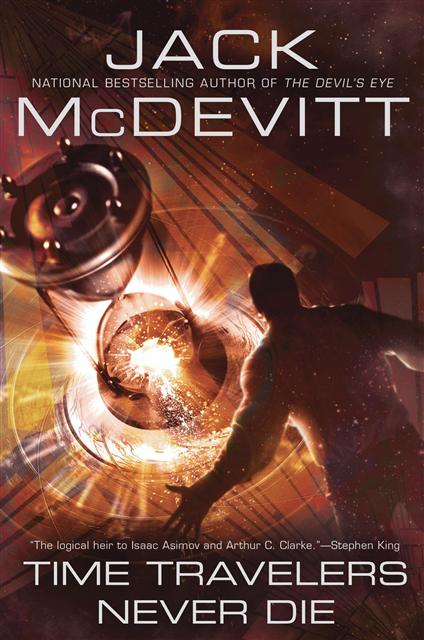 When researching a subject, sometimes I struggle for ground to cover in the course of the interview. In the case of writer Jack McDevitt I struggled to narrow down what to discuss, given the rich diversity of his life. The man is the definition of experiencing life to its fullest. Consider his bio (which can be found here), in which one learns McDevitt “is a former English teacher, naval officer, Philadelphia taxi driver, customs officer, and motivational trainer. With the nominations of Infinity Beach, Ancient Shores, Time Travelers Never Die, Moonfall, Good Intentions (cowritten with Stanley Schmidt), Nothing Ever Happens in Rock City, Chindi, Omega, Polaris, Henry James, This One’s for You, and Seeker, Odyssey, and Cauldron, his work has been on the final Nebula ballot twelve of the last thirteen years. His first novel, The Hercules Text, was published in the celebrated Ace Specials series, and won the Philip K. Dick Special Award. In 1991, he won the first $10,000 UPC International Prize for his novella Ships in the Night. The Engines of God was a finalist for the Arthur C. Clarke Award, and his novella Time Travelers Never Die was nominated for both the Hugo and the Nebula. Omega received the John W. Campbell Memorial Award for best SF novel, 2003. McDevitt lives in Georgia with his wife Maureen, where he plays chess, reads mysteries, and eats lunch regularly with his cronies.” My thanks to McDevitt for an enriching email interview, and to Kevin J. Anderson for his advice making this interview partially possible.
Tim O’Shea: Back in 2005, in excerpts from a Locus Online interview of you, you admitted: “I’m worried about what’s happening in the United States now with the right wing.” How much would you say the political climate of the world inspires some of your fiction (if at all)? Are you more or less worried about the United States these days?
Jack McDevitt: It’s four years ago. I suspect I was thinking about the tendency of the right to substitute flag-waving for thought. The primary responsibility of a citizen in a democracy is to keep informed, and to recognize that authority figures of whatever political stripe need to be watched. And controled. An extreme example came when the President took us to war without presenting any evidence. I will never forget JFK going on TV when he was getting ready to impose the Cuban missile blockade. Here are the photos. There are the missile sites. These are the capabilities that these missiles will have. Etc. We never saw any of that from Bush. Trust me. Let’s go get Saddam. The Republicans, who are now so concerned about waste, got in line. And the Democrats, with few exceptions, put political expediency before the nation’s welfare, and also climbed on board. Then, after we’d killed God knows how many innocent Arabs -Remember Shock and Awe?-, we re-elected the administration. Before the world, the American people showed their approval of what we’d done.
 Twitter RSS
- talkingwithtim: Listening to #LevonHelm sing The Night They Drove Old Dixie Down on @KBCS http://t.co/8oQMMHDo
- talkingwithtim: @BillWillingham @chris_roberson That statement reminds me of the word problems that stumped me as a kid #YeahIAmLousyAtMath
- talkingwithtim: RT @iaanhughes: Tonight on Road Songs the music of Levon Helm @KBCS 9 pm - 11 pm. #Levonhelm
- talkingwithtim: @chris_roberson I thought @allisontype was the queen of all things good (an umbrella which travel, of course, falls under)
- talkingwithtim: @CharlesSoule Greatly regret never getting to see him live #ButWeWillAlwaysHaveHisGreatMusic
Recent Comments