Chipper Jones: Final Game Press Conference “Three errors cost us the ballgame.” Pragmatic and a class act to the end.
Tag Archives: baseball
I Rarely Do Baseball Here
But today’s Atlanta Braves win (which was more of a Miami Marlins loss), can best be summed up with this tweet.
@TommyHanson48 @ajcbraves watching Tommy pitch today was like watching a drunk person succeed in disarming a bomb.
— Allan Turner (@ThisRedRocks) July 26, 2012
It amazes me, that as documented here, “Braves pitcher Tommy Hanson … allowed a career-high seven walks and seven stolen bases in five innings, but gave up just one run in a 7-1 win Wednesday afternoon at Marlins Park.”
Another Connection to My Father Gone: RIP Ernie Johnson Sr.

So tonight I was enjoying the tribute to legendary Atlanta Braves manager Bobby Cox as they retired his number (covered here by AJC beat reporter David O’Brien). I was holding out hope that the Braves would hit a season high six home runs (though five was fine with me) in honor of old #6, when my mood changed. TV announcers Chip Carey and Joe Simpson announced the passing of Atlanta Braves broadcast icon, Ernie Johnson Sr. And with that, my mood changed from happiness to near tears.
By the time I rolled into the O’Shea family (with my birth) back in the late 1960s, the family had seen some hard times-including (a mere 10 days before my arrival) the death of one of the teenage sons (after a long illness). My parents’ job was to raise a family through tough times-and it’s a job they did well. But the demands of family life and a professional career as a electrical engineer/salesman left my father with minimal desire for seemingly needless chit-chat at the end of a long day. Where my father was a man of few words, he was blessed (ahem) with a son who loved to talk.
One way a chatty kid and a stoic father could connect at the end of the day was Braves baseball. My father educated me in the ways of multitasking sports at an early age. In the days before Internet, satellite radio and cable TV, my father built a media situation room with one TV and one radio. If there was a basketball game on the TV, you can bet there might be a baseball game on the radio-or vice versa.
As I noted when Skip Carey died back in August 2008, the Braves announcing crew of the 1970s and 1980s unwittingly provided a lasting connection to my father. Whenever I heard Ernie, Skip or Pete Van Wieren, I was instantly with my dad again in the car or in the living room taking in one of those underperforming 1970s Braves teams. When I learned Ernie died tonight, part of me was emotionally 17 again standing in the rain outside a hospital where my father had just died.
I really hope the Braves broadcast team do more of a tribute to Johnson in the coming days. Chip did not mince words tonight in explaining how he learned far more from Ernie than he ever did from his own father, Skip.
The Braves management quickly announced tonight that for the remainder of the season they would wear a patch in honor of Ernie. I hope that patch gets to go to the World Series.
The Braves
News Blooper: Media Pundit Michael Wolff Misidentified as Baseball Expert
Courtesy of a post from Mediaite, I got to see this great news blooper, where the BBC host thought he was bringing a baseball pundit into a live discussion, when producers had accidentally (and unknowingly) switched to a feed of media pundit Michael Wolff, who was waiting to speak about Rupert Murdoch’s current troubles.
Watch and enjoy.
Impressive TV Show Pitch: Early Innings
I don’t often check out the videos on Vimeo, and after my latest discovery I feel foolish for that oversight. After recently watching a quirky Vimeo video (sent to me by a friend), I started looking around at other videos on the site. That’s how I discovered Early Innings, a TV pitch created by David Targan and Cinematography & Editing by Rod Blackhurst.
As detailed in the pitch, “In Early Innings we’ll experience the ride of a minor league baseball season with the people whose lives are inextricably bound by America’s Pastime … In year one we’ll follow the Burlington Bees at the lowest level of the minor leagues – Lo-A … Early Innings will ‘follow’ the Bees for an entire season, as 50 or so players chase the ultimate American Dream.”
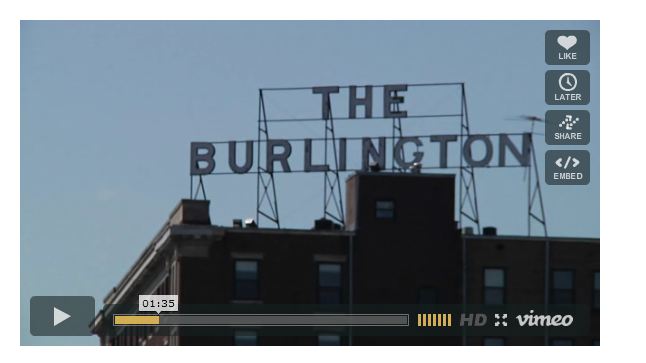
I do not know if this was a pitch for ESPN or MLB, but the insight I gained in this 10-minute pitch made me want to see more. I would love to embed the video here for you to watch it, but Vimeo prevents me from doing that in this case. That’s fine, however, as I think you gain a great deal more insight when you visit Blackhurst‘s website.
Media Memories: 1980 Braves & WTBS/Channel 17

So tonight I was at my mother’s house, looking for something that required me to dive into the folder of stuff my parents keep in a file for me (honor roll notices from grade school, summer reading program certificates from the 1970s…amazing stuff).
And then, in the file, I found a few of these. Tickets sent to me, due to my good grades (I’m fairly certain I was not a straight A student). As a kid, I did not appreciate the printed signature on the certificate (yep, that’s Ted Turner). The logo was WTBS on the eve of Turner Time (remember when TBS shows started at 5 minutes after the hour or half hour)-before the days of TBS Superstation.
Holding these tickets took me back to my childhood. Back in the days when the Braves were managed by Bobby Cox on his first round with the team (his second to last year as manager on this round)-but far from first place. It’s funny, as a kid I remembered them as always being a last place team, but as documented by Wikipedia, there were two teams (San Francisco Giants and San Diego Padres) worse off than the Braves.
[Apologies for the fuzzy quality of the image, O’Shea mansion does not have a readily available scanner, so I shot this with my wife’s Blackberry…]
Peter Morris on His Catcher Book
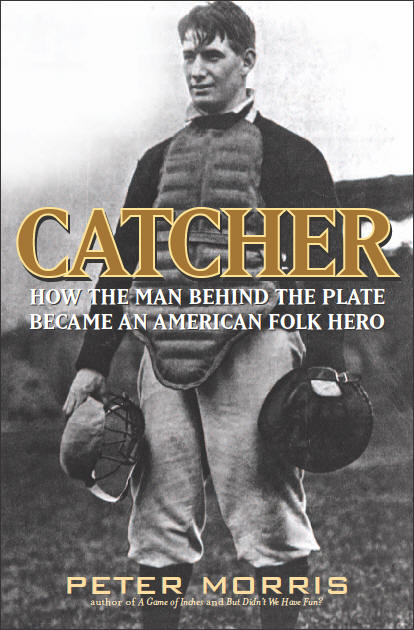 A month or so ago I was reading about Peter Morris‘ knowledge of baseball at The Second Pass. I was curious to learn more from (and about) the baseball historian. So I contacted him to see if he was interested in an email interview. Fortunately, he was and we got a chance to discuss his clear love of the game’s rich past and in particular, his latest book (published in April by Ivan R. Dee), Catcher: How the Man Behind the Plate Became an American Folk Hero.
Tim O’Shea: Given how much you know about the history of baseball, what long dormant rules that used to exist do you think could be re-introduced in the modern era to help revitalize the game?
Peter Morris: What today’s baseball fans rarely realize is that baseball was originally a sport with fast-paced, non-stop action. Catchers snapped the ball back to the pitcher and if the batter stepped out of the box or even looked like he wasn’t paying attention, the pitcher would try to sneak a pitch past him. While every sport has timeouts, only baseball has unlimited timeouts and I think some limit should be put on them. There’s no good reason that a batter should be allowed to step out and take as long as he wants after every pitch. Then you could put and enforce similar restrictions on the pitcher, as well as limiting the number of pickoff throws per at bat.
Chris Epting on Movies, Baseball and Music
 Sometimes the best leads for an interview happen in the library. Such was the case when I ran across pop culture historian Chris Epting‘s 2007 book, Led Zeppelin Crashed Here: The Rock and Roll Landmarks of North America. I was impressed with Epting’s research, after flipping through the book, which aims to take the reader “through America’s rich rock ‘n’ roll history with the musical landmarks detailed in this extensive collection. Nearly 600 locations, including birthplaces, concert locales, hotel rooms, and graves, are neatly compiled and paired with historical tidbits, trivia, photographs, and backstage lore—from the site where Elvis got his first guitar and Buddy Holly’s plane crashed to Sid and Nancy’s hotel room and the infamous ‘Riot House’ on the Sunset Strip.” I tracked Epting down at his website and he agreed to an email interview. We covered a great deal of ground and I had a substantial amount of fun along the way. Hopefully you’ll have fun reading this.
Tim O’Shea: Do you think your affinity for pop culture began where you grew up-in Westchester County, New York-an area where you note: “certain notable people became attracted to the area. Jackie Gleason, for one. Other actors. Writers. Thinkers. Even Peter Frampton (on the heels of the blockbuster album “Frampton Comes Alive”)”
Chris Epting: It definitely started at that point in my life, but I think it was more a process of the times than the geography. That said, our close proximity to New York City was valuable in terms of what were exposed to, but in general I think growing up in the thick of the 1970s is what really did it for me. It was an interesting time in that you had some great directors breaking out (Scorcese, Coppola, etc.) some cutting edge TV (All in the Family, MASH, etc), great radio (both am/fm), decent theater—a lot of culture was in flux, and the churn produced, I think, a wonderful storm of pop culture fury that still influences a lot of things today.
Atlanta Jewish Film Festival: Holy Land Hardball
Holy Land Hardball, a documentary directed by Erik Kesten and Brett Rapkin, is set to have its Atlanta premiere at the 2009 Atlanta Jewish Film Festival (AJFF) on January 22 and 23. The 84-minute, 2008 film “follows the dubious formation of the Israel Baseball League (IBL) by Larry Baras, a Boston bakery owner with no sports management experience. Stirred to action by a midlife crisis, Baras recruits a diverse collection of executives and ballplayers for the IBL, the first ever professional baseball circuit in the Middle East. The team’s challenging task is to draw Israelis to America’s pastime, a game they’ve gone 5,767 years without.”
 It’s an interesting tale, which I was able to watch thank to an AJFF screener, both from a baseball and family sense. It’s got a comical tinge to the project, for example, as the baseball tryouts were being shown the Talking Heads’ song, Road to Nowhere, was played. Throughout the film, you feel like the effort to form theIBL is doomed, whether it was or not. But that aspect of the tale was secondary to me. For me, it’s a story about loss and the importance of family, and in particular father and son dynamics.
Continue reading Atlanta Jewish Film Festival: Holy Land Hardball
Tom Jones on Working at the Ballpark
 Tom Jones made my day when I recently discovered his book, Working at the Ballpark: The Fascinating Lives of Baseball People from Peanut Vendors and Broadcasters to Players and Managers. My late father instilled in me a love of baseball. So right about now, less than a month after the World Series has ended … I’m already missing baseball. I was even more pleased when Jones agreed to this email interview. Here’s the official background on the book and its author, prior to delving into the interview:
“Working at the Ballpark is an inside look at what people in major league baseball do for a living and how they feel about their jobs by taking readers into dugouts, clubhouses, bullpens, press boxes and executive offices where fans dream of going. In the rich oral history tradition of Studs Terkel, this is an entertaining collection of 50 candid, engaging interviews with players, managers, coaches, peanut vendors, ushers, groundskeepers, clubhouse guys, executives, broadcasters, mascots, and others who work at a major league ballpark: From John Guilfoy, who sells sausages behind the Green Monster at Fenway Park, to Chris Hanson, who plays ‘Bernie Brewer’ in Milwaukee, Johnny ‘from Connecticut,’ who is a street ticket hustler, to Glove Glove shortstop Omar Vizquel, who anchors the infield at AT&T Park.
Working at the Ballpark provides fascinating and gritty details about the working lives of men and women who are passionate about baseball. These are their personal, poignant stories. In their own words.
Tom retired in 2005 after 30 years with the State of California where he worked as a legislative director in the administrations of the last five California governors. He lives in Sacramento.”
With the recent passing of Studs Terkel, it really struck a chord with me to see Jones reference Turkel. It’s nice to know there’s at least one writer out there trying to carry on Terkel’s passion for oral history.
Tim O’Shea: How long had you been thinking about writing the book?
Tom Jones: I began thinking about writing an oral history book in 2004, the year before I retired from State government. Initially, I intended to compile an updated version of Studs Terkel’s Working, to be called Working: Revisited. I corresponded for a while with a guy who taught oral history and also was a close friend of Terkel. But one evening I was browsing books at a Borders and came upon Gig—a book exactly written as I wanted to do. That ended my first book project.
Two years later while running along the American River bike trail in Sacramento while training for the 2006 Boston marathon, I thought about putting something I enjoy—baseball—into the same kind of oral history format as Terkel’s work (the marathon was four weeks away). After returning home from running, I quickly showered, and then checked the schedule for the Boston Red Sox and the Houston Astros (my flight made a stop in Houston). Both teams were playing at home during my travels.
I made a list of every baseball occupation I could think off, and sent letters describing the book proposal to the owners of the Red Sox and the Astros, and to the Boston Globe (looking for a sports columnist). The Red Sox didn’t respond to my first request (months later they did; Red Sox employees—including Johnny Pesky-are included in the book). Dan Shaughnessy of the Globe invited me to his house for an interview, and the evening of the marathon I received an e-mail invitation from the Astros to interview their people enroute back to Sacramento.