Archive for category Literature

Sara Ryan on Empress of the World

Empress of the World

Back in 2001, librarian and novelist Sara Ryan captured folks’ attention with her young adult novel, Empress of the World. The book (described as “about friendship, love, and the sometimes blurry lines between the two”) is an Oregon Book Award winner, an ALA Best Book for Young Adults and was a finalist for a Lambda Literary Award. Recently the book was re-released in an expanded edition. Ryan and I conducted an email interview about it, as well as delving into her upcoming comics work, which includes Bad Houses, a collaboration with Carla Speed McNeil. This interview goes in some pleasant directions and I was lucky to get to interview Ryan.

Tim O’Shea: In researching our interview, I searched for your Tumblr page but accidentally discovered the number of people that quote your work (and hashtag it “Sara Ryan”). I think it safe to assume that any writer wonders how much their work resonates with people. How affirming is it when you see people quoting your work

Sara Ryan: Here’s where I expose my ignorance of the finer points of Tumblr. Until you pointed it out, it hadn’t occurred to me to check if anyone had tagged posts about me/my work. Now that I know said posts exist, I’m certainly pleased!

Speaking of Tumblr, visiting your Tumblr page it becomes obvious (at least to me) that you love the power of photography.

I do. Photography actually connects very much to comics writing for me; I can’t draw, but I can compose images with my camera. I try to use that same visual sensibility when I write panel descriptions — while leaving enough room for the artist to bring their own interpretation, of course.

Read the rest of this entry »

, , , , , , , , , , , , ,

No Comments

Still Impressed by Donald Sobol

Encyclopedia Brown

Apparently last week the world lost children literature author and Encyclopedia Brown creator, Donald Sobol.

Most kids my age grew up reading the books. I tried to get my son interested in the series more recently, but could not get him hooked on it. I may need to try a harder sell.

Reading the obituary, I was impressed to learn that Sobol wrote almost until the end of his life. In fact, this October will see the release of the 28th book in the series, Encyclopedia Brown and the Case of the Soccer Scheme.

In the wake of his death, I went looking for an interview with Sobol. I was fortunate enough to discover  Just My Show: The Retro Pop Culture Podcast. Back in 2007, the show interviewed him and he shared how he kept the books ageless. He noted that he once referred to an expensive car in one of the earlier books and quoted the cost of the car ($5,000). Of course, by today’s standards, that’s not a substantial amount for a car–and Sobol expressed his appreciation that in revised releases of the book the cost had been edited.

Also in the interview, Sobol referenced newspaper column of his, the Two-Minute Mystery, that lead to him pursuing Encyclopedia Brown. Thanks to Google News’ archives, I was able to find one of the columns from 1967.

Sobol’s impact on writers and readers is far reaching, as evidenced by this tribute by crime novelist Jonathan Hayes on NPR.

Thanks for enriching a lot of folks’ childhood reading, Mr. Sobol.

, , , , ,

No Comments

John Irving Appeared On Craig Ferguson?

Where the hell was I the night John Irving was on Craig Ferguson? So glad that CBS posts this stuff on YouTube.

He debates Irving about Michael Caine’s accent in The Cider House Rules. It makes for fun TV.

, , ,

No Comments

Anna Trodglen & Anthony Owsley on Little Red Riding Hood

Little Red Riding Hood

Next Friday, May 11, Anna Trodglen, creator of the online comic strip Biscuits & Bellyrubs, will unveil her translation and illustration of Little Red Riding Hood, the classic children’s story, from the original German. The book celebration is set to be held at the Young Blood Gallery (636 N Highland Ave. Atlanta, GA 30306/404-254-4127), from 6 to 9 PM. As befits a children’s book, kids are encouraged to attend (bring the parents of course) the gathering, where snacks and sodas will be served. As an added bonus, Anna’s musical collaboration with husband Dugan Trodglen and John Armstrong (aka the legendary band, DQE) will perform a set. In anticipation of the event, Anna and the book’s designer/letterer Anthony Owsley allowed me to email interview them. (Eagle eye readers will note this marks the second time I have gotten to interview Anna [the first time being in 2010]) My thanks to Trodglen & Owsley for the interview.

Tim O’Shea: What inspired you to tackle Little Red Riding Hood, rather than translating one of the myriad other German folklore tales?

Anna Trodglen: I wanted to do Little Red Riding Hood because I was really drawn to the Wolf. He seemed very interesting and as a dog relative he was appealing to me. I also liked the limited number of cast in the story and that there were three distinct female characters.

Read the rest of this entry »

, , , , , ,

No Comments

Crickett Rumley on Never Sit Down in a Hoopskirt and Other Things I Learned in Southern Belle Hell

Never Sit Down in a Hoopskirt and Other Things I Learned in Southern Belle Hell

When a mutual friend told me about Young Adult novelist Crickett Rumley‘s 2011 book, Never Sit Down in a Hoopskirt and Other Things I Learned in Southern Belle Hell, I immediately decided I had to email interview the author. Here’s the official scoop on the book: “Expelled from thirteen boarding schools in the past five years, seventeen-year-old Jane Fontaine Ventouras is returning to her Southern roots, and the small town of Bienville, Alabama, where ladies always wear pearls, nothing says hospitality like sweet tea and pimento cheese sandwiches, and competing in the annual Magnolia Maid Pageant is every girl’s dream.

“But Jane is what you might call an anti-belle, more fishnets and tattoos than sugar and spice. The last thing on her mind is joining the Magnolia Maid brigade and parading around town in a dress so big she can’t fit through a door. So when she finds herself up to her ears in ruffles and etiquette lessons, she’s got one mission: ESCAPE.”

This interview was conducted in late 2011. My thanks to Rumley for her time and humor.

Tim O’Shea: When did you first realize you derived creative satisfaction from writing teen comedy?

Crickett Rumley: Being a teenager is one of the most terrifying states of existence on earth. At least it was for me. On some level, everybody feels awkward and is searching for who they are, whether they are the most popular girl in school or the computer geek who hides in the corner and only comes out to answer calculus questions. Under those conditions, emotions run at full velocity – the highs are stratospheric, the lows are deeper than the sea. Everything means everything. So I’ve always felt that period in a character’s life is ripe for story-picking.

Read the rest of this entry »

, , , , , , ,

No Comments

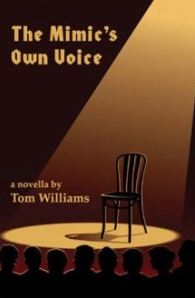
Tom Williams on The Mimic’s Own Voice

The Mimic’s Own Voice

Tom Williams’ novella, The Mimic’s Own Voice, was released in 2011. Williams was kind enough to entertain a few questions of mine in this email interview (conducted in early December 2011). Williams’ story is a quirky consideration of mimicry and biography. And I’m not just saying that because of the kind sentiment he expresses at the start of the interview. As noted in his bio: “A former James Michener Fellow, he has received individual artist fellowships from the Wisconsin Arts Board and the Arkansas Arts Council. He currently is an associate editor of American Book Review” and Department Chair/Professor of English at Morehead State University. My thanks to Williams for his time and thoughts as well as Susan Henderson for helping to arrange this interview.

Tom Williams: Tim, let me first say thanks for agreeing to do this interview. One of the great things about having a small press book is that I’ve been required, pretty much, to do a lot of my own publicity. Yet I get to meet (in this virtual way) people like yourself, who do so much for writers and, it seems to me, receive so little in return. I hope I don’t stumble too much over these great questions.

Tim O’Shea: In developing this story, how early did you realize it was best suited as a novella, as opposed to a novel or short story?

Williams: As evidence of my unerring commercial intuition, I knew almost right away that it was a novella. The opening lines had a certain kind of tone and were pointing toward an almost historic sweep. I thought for a time it might be a novel but sensed the appropriate length was short of novel length after I had gone through, for the first time, my comedy history–from the one liner royalty to the vernacular story tellers to the mimics to the social critics to, finally, the observational comics. To flesh it out too much would, I thought, ruin the joke, and to try to bring it in under 30 pages would leave too much out.

Read the rest of this entry »

, , , , , , , , , , ,

No Comments

Masha Hamilton on Afghan Women’s Writing Project

This email interview with Afghan Women’s Writing Project (AWWP) founder, award-winning author Masha Hamilton, was set months ago, but I dropped the ball. In a sense, though, I am glad that this interview was delayed. This time of year, I like to think people are more charitable. So once you read about the AWWP, an organization devoted to giving Afghan women the ability to voice their opinions without the filter of male relatives or the media–and visited the AWWP website–I hope you consider donating to its cause. My thanks to Hamilton for her time and thoughts, as well as to AWWP’s Lynn Harris for helping to arrange this email interview.

Tim O’Shea: In a sense, do you think mentors benefit almost as much from the experience as the contributors?

Masha Hamilton: Absolutely. A bridge is being built between Afghan women and both mentors and readers abroad that I think is important to both sides. To read some of the mentors’ comments on our site, look here. Here is one quote from Stacy Parker Le Melle, but you can pick any one you’d like:

“Magical. How else to describe sitting at my computer in Harlem, USA, and connecting with young women in Afghanistan, women who want to better themselves as communicators so that they can be heard at home and all over the world? I cannot thank Masha Hamilton and her partners enough for creating this cyberspace classroom. At times, it feels like we’re meeting in our dreams.”

Read the rest of this entry »

, , ,

No Comments

Katie Roiphe’s Essay on David Foster Wallace’s Syllabuses

Katie Roiphe’s essay about the late  David Foster Wallace’s syllabuses at Slate fascinates me on two levels. First, that in this digital age, with one click of the button I can access the syllabus of a professor (for a class I never took at a college I never attended). Secondly, the content of the documents themselves are eye-opening, for the assertive way (noted by Roiphe) that Wallace addresses his students. Consider this excerpt:

Students of course love teachers who step out of the formality of academic life, who comment on it, but very few do so as more than theater. Very few commit to it the way David Foster Wallace commits to it. “This does not mean we have to sit around smiling sweetly at one another for three hours a week. … In class you are invited (more like urged) to disagree with one another and with me—and I get to disagree with you—provided we are all respectful of each other and not snide, savage or abusive. … In other words, English 102 is not just a Find-Out-What-The-Teacher-Thinks-And-Regurgitate-It-Back-at-Him course. It’s not like math or physics—there are no right or wrong answers (though there are interesting versus dull, fertile versus barren, plausible versus whacko answers).”

Go read the article, follow the links. It’s fun stuff.

, , ,

No Comments

Novelist David Liss on The Twelfth Enchantment

Article first published as Novelist David Liss on The Twelfth Enchantment on Technorati.

The Twelfth Enchantment

In David Liss‘ new novel, The Twelfth Enchantment (Random House), he has decided to mix historical fiction with a dash of magic and the surprise presence of Lord Byron for good measure. Set in early 1800s England, Liss constructs a tale of the young down-on-her-luck Lucy Derrick who fears her best option may be to marry an unappealing fellow. Add to the story’s mix a battle between the Industrial Revolution and Luddites. Liss is clearly an author that loves to research his subjects–and fortunately enjoys discussing his latest novel in this interview.

Not every novelist, even one known for his historical fiction, would tackle the Luddite Uprising–how did you decide upon utilizing that historical event?

It developed naturally from my interest in wanting to write about the economics of the Regency period. I’ve always been drawn to significant moments in the history of capitalism, as well as labor history, so the Luddites were a perfect fit for my interests. Guys who express their anger at the system by breaking machines and burning down buildings? That always makes for a good story! Most people think of Luddites as people who hated technology, but that wasn’t the case. They were skilled laborers who were being left behind by the industrial revolution. Communities where artisans had supported their families for generations were being destroyed by the factory system. This was serious stuff.

Read the rest of this entry »

, , , , , , , , ,

No Comments

Novelist Diana Abu-Jaber on Birds of Paradise: A Novel

Birds of Paradise: A Novel

Article first published as Interview: Novelist Diana Abu-Jaber on Birds of Paradise: A Novel on Blogcritics.

If you are a regular listener to NPR, you likely have heard one of novelist Diana Abu-Jaber‘s frequent essays. Next week (September 6, to be exact) marks the release of the award-winning author’s newest novel, Birds of Paradise [Editor's note: Of course, the book is out as of this past Tuesday]. While I was already aware of Abu-Jaber, thanks to NPR, I did not realize she had finished her new book until an early July tweet by Bethanne Patrick (aka @thebookmaven). Soon after learning of the new novel, I reached out to Abu-Jaber for an email interview–and she was more than happy to entertain my queries. As described by her publisher (W. W. Norton & Company): “In the tropical paradise that is Miami, Avis and Brian Muir are still haunted by the disappearance of their ineffably beautiful daughter, Felice, who ran away when she was thirteen. Now, after five years of modeling tattoos, skateboarding, clubbing, and sleeping in a squat house or on the beach, Felice is about to turn eighteen. Her family—Avis, an exquisitely talented pastry chef; Brian, a corporate real estate attorney; and her brother, Stanley, the proprietor of Freshly Grown, a trendy food market—will each be forced to confront their anguish, loss, and sense of betrayal. Meanwhile, Felice must reckon with the guilty secret that drove her away, and must face her fear of losing her family and her sense of self forever.” In addition to the book, we also delve into her recent mention in a New York Times piece on email manners.

How early in the development of Birds of Paradise did you realize it had to be set in Miami–and what appealed to you in terms of setting it there?

Miami was present from the very first page. My husband and I moved to Miami eight years ago and I knew I wanted to use it as a setting. Ever since my second novel, Crescent, I’ve been very inspired by sunlight and water and I always like to use a strong setting for my stories– like the city of Syracuse and the blizzard that seems to keep blowing throughout Origin, my third novel. Birds of Paradise is a reflection of Miami’s many layers– its outward dazzling tropical colors and beauty, its racial and cultural collisions. I’m fascinated by that complexity and challenged by it. Setting my new novel here gave me a way to reflect on my adopted city and to push myself to learn more about it.

Read the rest of this entry »

, , , , , , , , , ,

2 Comments